A second opinion on a CBCT or OPG means a different qualified reader reviews the same images and gives an independent report. It is worth asking for before major, costly or irreversible treatment, when a report is unclear, or when the findings do not match your symptoms. It does not replace your Dentist, and it usually supports their plan.
If a Dentist has told you that you need an implant, a surgery or a long course of treatment, it is natural to wonder whether the scan has been read properly. Published studies of repeat readings suggest that most second reads agree with the first, and that a minority may differ in a way that matters. Knowing which situations make a difference more likely helps you decide whether to ask.
The decision to ask depends on three things: what is at stake in the treatment, how clear the first report is, and how much a different reading could change. Below: what the evidence says about how often reads differ, what kinds of changes a re-read tends to bring, how the process works, what to ask about fees and turnaround, and how to raise it with your Dentist. Composite examples are labelled as such and do not belong to real patients.
What a Second Opinion on a Scan Actually Is
A scan has two parts: the images and the interpretation. A second opinion on the scan is a fresh interpretation of the same images by another qualified person, ideally a Dental and Maxillofacial Radiologist (why that distinction matters), who has not been involved in the treatment. It is different from a second opinion on treatment, in which another clinician examines you and offers a plan.
The reader works from the original image files, not from a printout, a screenshot, or the first report. They may be given the first report for comparison or may be asked to read blind first. The result is a separate written report with or without additional processed image sections, that your Dentist can compare with the first.
When a Second Read Is Worth Asking For
Before major treatment. Implants, bone grafting, jaw surgery, removal of an impacted tooth near a nerve, or full-mouth rehabilitation. The cost of a second read is small when compared to the cost of getting the plan wrong.
When the report is unclear. It uses vague phrases, describes findings without saying what they mean, or leaves questions open. How to read a CBCT report shows what a clear one looks like.
When the findings do not match your symptoms. Persistent pain with a "normal" scan, or a dramatic finding with no symptoms.
When something unexpected was found. A lesion, an unusual shape or a finding outside the teeth. What to expect when a scan shows an incidental finding.
When two clinicians disagree. A neutral reading can help settle which view the images support.
When no qualified reader reported the scan. Some scans are viewed by the treating Dentist and never formally reported.
When you simply want reassurance before a decision that is hard to undo.
When It Probably Is Not Needed
A routine bitewing or periapical for a straightforward check-up.
A clear report, matching the examination, for a low-risk procedure.
A repeat scan for a stable, known finding that has been reported before.
A second opinion is a tool for uncertainty and high stakes, not a ritual for every image.
What a Second Read Can Change
The examples below are composite and de-identified. They illustrate patterns that Radiologists describe in practice. They are not statistics, and no figure is implied for how often they occur.
| Category of change | What it looks like | Effect on the plan |
|---|---|---|
| A finding was missed | A second canal, a small lesion, a root fracture line or a sinus change that the first report did not mention | The plan is revised or investigated further before treatment |
| A finding was over-read | A normal variant or a shadow described as disease | Unnecessary treatment is avoided |
| A measurement differs | Bone height or distance to a nerve is given differently by the two readers | The safety margin or the implant size changes |
| A diagnosis is refined | A "cyst" is described with features that suggest something else, or the reverse | A biopsy, referral or different treatment is chosen |
| An important limit was not stated | Artefact or an incomplete field hid part of the area, and the first report did not say so | Further imaging or caution in surgery is advised |
| Agreement | The second reader reaches the same conclusion | The patient and the Dentist proceed with more confidence |
A second read that confirms the plan is not wasted: it removes doubt, and as the next section shows, confirmation is the usual result. A case in which a jaw lesion was not what it first appeared shows the other end of the spectrum, where reading carefully made the difference.
What the Evidence Says About How Often Readers Differ
No large, verified study of second reads on Dental CBCT scans was found for this article, so the figures below come from medical neuroradiology, where second-opinion consultations have been studied more. They show the general pattern and should not be read as Dental rates.
In a study of 4,534 outside head and neck, brain and spine studies re-read at a large academic centre, 347 (7.7%) showed a clinically significant discrepancy between the original and the second report [1].
In an internal quality-assurance review of 2,162 studies re-read within one academic neuroradiology division, 39 (1.8%) had a clinically significant discrepancy [2].
Put together, more than 90% of re-reads did not differ in a way that significantly changed the report. A minority did, and those are the cases a second opinion exists to catch. The rate depends on the type of scan, how complex the case is, who read it first and what counts as a major difference, so a patient cannot read their own odds from these numbers. They support a measured conclusion: a second read is a reasonable safeguard when the stakes are high, and it is not evidence that first reports are generally unreliable.
Why Two Qualified Readers Can Differ
Differences between readers are normal in all types of medical imaging, and they have understandable causes.
Interpretation involves judgement, especially in case of borderline or subtle findings.
Training and experience in Dental and Jaw imaging vary between readers.
The clinical information given to each reader may differ.
The report may be written in the context of a different question.
Time and workload affect thoroughness.
Image quality can limit what any reader can say with confidence.
That is also why a reading by a specialist in jaw imaging has value for complex cases. It also means a difference between two reports is a reason to talk, not to assume that one reader is careless.
How the Process Usually Works
Ask your Dentist for the original image files. They are usually in DICOM format. A screenshot or printed film is not enough for a proper re-read.
Collect the first report, if there is one, and the reason the scan was done.
Write the question. For example, "Assess bone available for an implant at 36 and the relationship to the nerve," or "Describe the lesion at the apex of 21 and give a differential."
Send the files securely to the reporting service, usually through an online upload. How scan data is stored and protected explains what to ask about privacy.
The reader reviews the volume and writes an independent report. A thorough read takes time.
Receive the report and discuss it with your Dentist.
Many Radiologists work remotely; how remote CBCT reporting works, describes the process. What matters is who the reader is, what is their qualification and who is accountable for the report.
Fee and Turnaround: What to Ask
Fees and timelines differ between services, and they should be stated before you send anything. Several things move both.
| Factor | Effect on fee | Effect on turnaround |
|---|---|---|
| Size of the scan (field of view) | A larger volume has more to review | A larger volume takes longer to read |
| Complexity of the question | A single-site question costs less than a full-volume review | A complex question needs more time |
| Whether a first report is supplied | May save little, as the reader still reviews the images | Little effect |
| Signed written report or opinion only | A signed report is usually priced higher | A written report takes longer |
| Urgency requested | Urgent handling may cost more | A thorough report is not instant, even when urgent |
Before sending anything, ask:
What is the fee, and does it cover a full written report?
What is the usual turnaround, and what happens if the case is urgent? A thorough report is not instant.
Who will read the scan, and what are their qualifications?
What do I receive: a signed report, annotated images?
Can I speak to the reader if I have questions?
How are my files stored, and for how long?
Ten questions to ask before choosing a Dental imaging centre covers the same ground for first-time scans.
How to Raise It with Your Dentist
Some patients worry that asking for a second read will offend their Dentist. In practice, careful clinicians welcome it, because it protects them as well as the patient. A few phrases keep the conversation easy:
"This is a big decision, and I would feel more comfortable with a second read of the scan. Could you give me the image files?"
"I do not doubt your plan. I would like the scan reviewed by a Radiologist before we start."
"Could you tell me how the report was reached, and whether a second reader would be useful?"
Your Dentist can also ask for the second read on your behalf, adding the clinical details that make it more useful. A second read that supports the treating Dentist, and records that a specialist reviewed the scan, is good for everyone.
What a Second Opinion Does Not Do
It does not examine you. A reader of images cannot feel the tooth, test its vitality, or see the gum.
It does not replace the treating clinician's judgement. The clinician combines the report with the examination.
It does not make a poor image better. If the scan was badly taken, the second reader can only say so.
It does not always give a different answer.
What Makes a Second Reader Qualified
Not every report is equal, and the value of a second read depends on who gives it. Reasonable things to check:
Specialist training. A Dental and Maxillofacial Radiologist has trained specifically in reading jaw and tooth imaging, including CBCT. A general Radiologist may be an excellent clinician but have less exposure to the teeth and jaws.
Registration and qualification. The reader's name, qualification, and registration number should be on the report.
Experience with your kind of question. Implant planning, jaw lesions, joints and airways each call for a particular experience.
A clear report format. The report should state the technique, the findings by region, the limitations and an impression.
Accountability. There should be a named person who signs the report and can be contacted about it.
A Composite Example of Comparing Two Reports
Imagine a patient who was advised to get an implant in the lower right molar region. The first report says there is "adequate bone height." A second reader, looking at the same volume, describes a branching canal and measures a shorter safe height, with a note that metal artefact limits assessment of the buccal bone. The two readers do not disagree about the presence of bone. They disagree about how much of it is safe to use, and the second report states a limitation the first did not mention.
The Dentist reviews both, calls the second reader, and adjusts the plan to a shorter implant with a larger safety margin. The patient is told why. No one has been proved wrong. The plan has simply been made with better information. This is composite and not a real case, but it is the kind of change a careful second read can bring.
Privacy and Consent When You Send a Scan
Ask who will see the images and the report, and whether they are stored.
Ask how the files are sent. Secure, encrypted upload is better than email or a messaging app.
Ask whether the scan will be used for teaching or research and say no if you do not agree.
Remove or limit identifying details where the service allows.
Confirm how long the service keeps your files and how you can ask for deletion.
Dental scans are health data. Treat them accordingly and expect a clear answer to each of these questions.
Cost Against Stakes
A second read costs money and time, and the question is whether it is proportionate. For a single, straightforward filling the answer is clearly no. For a plan that costs a large sum, involves surgery near a nerve or cannot be reversed, a second read is a small fraction of the total. A useful habit is to compare the fee with the cost of the planned treatment and the cost of getting it wrong, not with the cost of the scan alone.
A Second Opinion on the Scan Versus a Second Opinion on the Treatment
| Aspect | Second opinion on the scan | Second opinion on the treatment |
|---|---|---|
| Who gives it | A Radiologist who reads images | A clinician who examines you |
| What is reviewed | The image files | You, your history and the images |
| What it answers | "What does the scan show?" | "What should be done?" |
| When it helps | Unclear or high-stakes findings | Unsure about the treatment plan itself |
| Typical output | A written imaging report | A treatment recommendation |
The two can be combined, and many patients benefit from asking for the first before the second, because the report gives everyone the same factual starting point.
While You Wait for the Second Read
Keep your original image files and report safe.
Do not start the planned treatment, if it cannot be undone, until the second report arrives.
Keep taking any medicines and following any advice your Dentist has given for pain or infection.
Write down questions for your Dentist.
Ask the reader or the service how long it will take, so that you can plan.
For Dentists: Best Practices to use a Second Read
Tell the patient why you are asking for it, framing it as care and not as doubt.
Send the question, the history and the original files, not only the images.
Share the first report if there is one, unless a blind read is wanted.
When the reports differ, discuss with both readers and decide on the clinical picture.
Record both reports in the patient's notes.
Use the outcome as feedback. 3 questions every Dentist should be able to answer after opening a CBCT gives a useful discipline for the first look you take yourself.
For the other direction, a guide for referring Dentists covers how to get a report with the first request, that rarely needs a second opinion.
Questions to Ask the Second Reader
Does your report answer the specific question I sent, and where does it differ from the first report?
Which findings are you confident about, and which are uncertain?
Is there any limitation, such as artefact or an incomplete field, that affects your conclusions?
Would any further imaging help?
Can you speak to my Dentist about the differences?
A good reader welcomes these questions. The answers also help your Dentist, who has to turn two documents into one decision.
Common Mistakes
Sending a screenshot or phone photo of the scan.
Sending the images without the question or history.
Starting treatment while the second read is awaited.
Treating any difference as proof that the first reader was wrong.
Not telling the treating Dentist.
Choosing a reader on price alone, with no information about who they are.
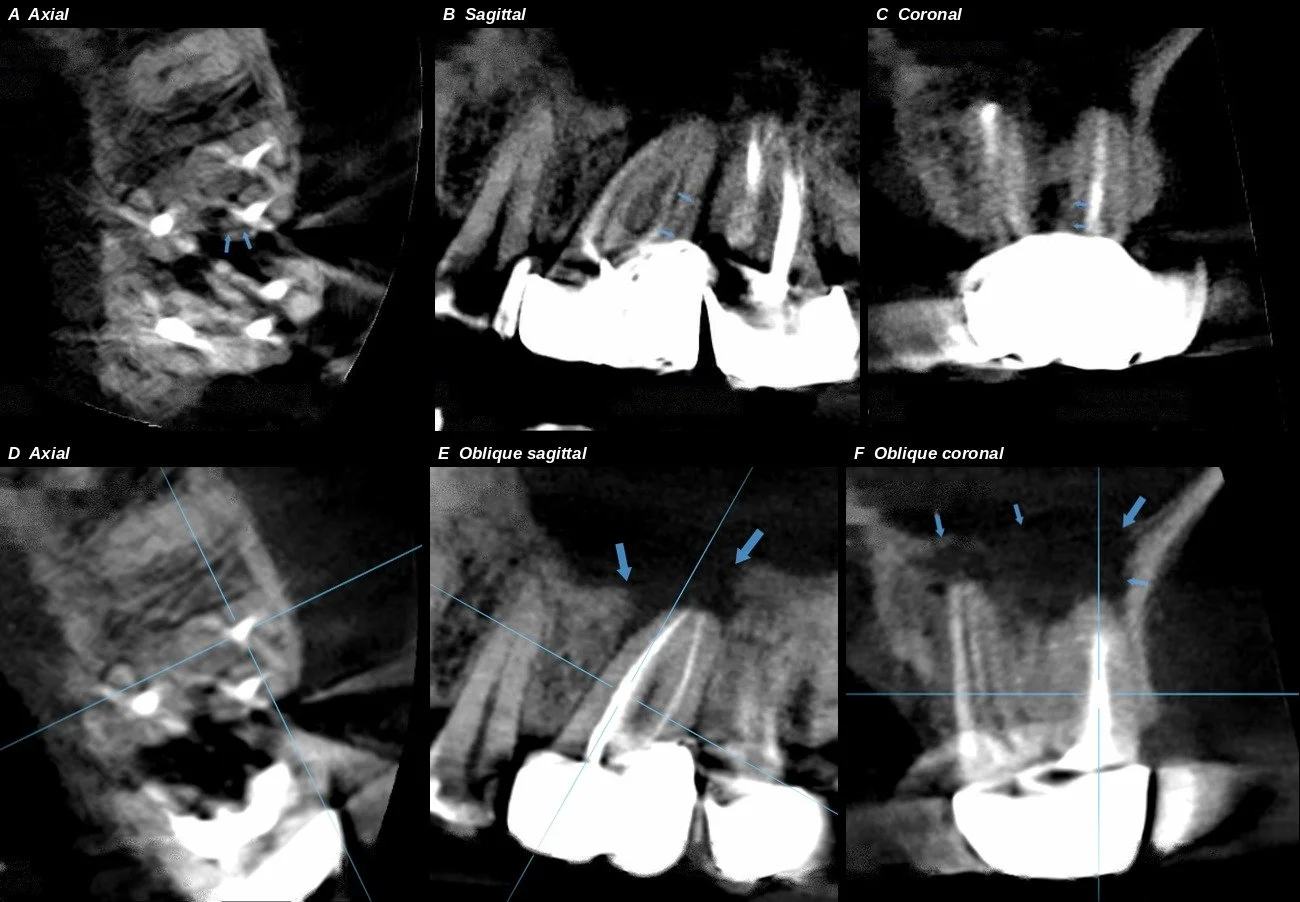
Figure. De-identified CBCT of the case described below, an upper left first molar (tooth 26) with a root canal filling and crown. A to C: axial, sagittal and coronal views, with arrows on the suspected craze line. D to F: further oblique views of the same tooth, with arrows marking the changes noted on the second read.
“A patient presented to a Dental Clinic with severe pain on biting in upper left back region since last few days. Root canal treatment and a full coverage crown had already been done for this tooth 6 months ago. A CBCT scan of this area performed at the Dental Clinic did not reveal any obvious periapical pathology; however, when the scan was reviewed again by a qualified Radiologist, they found a prominent craze line or fine crack and infra-bony defect on adjoining root wall. This explained the pain on biting and also simplified the further management approach for the Dental Clinic.”
Frequently Asked Questions
-
An independent interpretation of the same CBCT images by another qualified reader, ideally a Dental and Maxillofacial Radiologist, resulting in a separate written report.
-
Before major or irreversible treatment, when the report is unclear, when the findings do not match your symptoms, when something unexpected was found or when clinicians disagree.
-
Careful clinicians generally welcome it, particularly before major treatment. Present it as wanting more certainty, not as doubting them.
-
The original DICOM files, the first report if there is one, a short history and a clear question.
-
No. A reader needs the original data to scroll, measure, and view in all planes.
Related Reading
Questions about a specific scan or report? The contact page lists how to reach the team.
References
Zan E, Yousem DM, Carone M, Lewin JS. Second-opinion consultations in neuroradiology. Radiology. 2010;255(1):135-141. doi:10.1148/radiol.09090831
Viertel VG, Babiarz LS, Carone M, Lewin JS, Yousem DM. Quality control in neuroradiology: impact of trainees on discrepancy rates. AJNR Am J Neuroradiol. 2012;33(6):1032-1036. doi:10.3174/ajnr.A2933
